Commercial contractors and site managers in MetroWest and Lake Nona rely on low-profile waste holding tanks to keep field operations OSHA-compliant before municipal sewer connections activate. A standard 250-gallon…
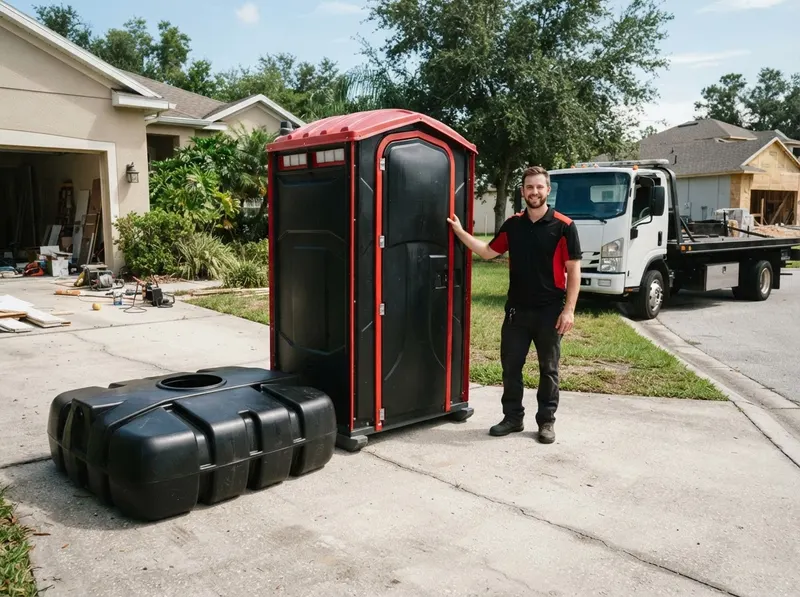
Commercial contractors and site managers in MetroWest and Lake Nona rely on low-profile waste holding tanks to keep field operations OSHA-compliant before municipal sewer connections activate. A standard 250-gallon tank slides under a mobile office trailer chassis with an 11-inch vertical clearance, plumbing directly into internal toilets and sinks via heavy-duty rubber Fernco couplers. For major developments near the Orange County Convention Center or infrastructure builds through the SoDo District, a 500-gallon or 1,000-gallon tank handles high-volume daily output from 15 to 30 full-time field personnel. Choosing a 250-gallon unit preserves ground footprint in tight infill zones like College Park and Thornton Park, but demands scheduled weekly pump-outs; stepping up to a 500-gallon tank doubles storage capacity to safeguard against weekend overflows, trading off an extra four feet of lateral site clearance.
Florida heat accelerates bacterial breakdown and gas production, making sealed plumbing connections non-negotiable for site comfort. Each tank features heavy-walled, high-density polyethylene construction that resists puncture from crushed rock and withstands sustained direct sun exposure in unshaded subdivisions across Dr. Phillips and Baldwin Park. Routine pump-out logistics must account for service vehicle access: vacuum pump trucks carry 30-foot suction hoses and require a firm, flat 12-foot driveway or packed-dirt path to clear property curbs without cracking concrete sidewalks or damaging manicured turf in Audubon Park Garden District and Colonialtown North.
Site operations follow a defined, four-step logistical workflow. First, the contractor verifies frame ground clearance and selects a level location adjacent to the drain manifold. Second, technicians spot the tank, set 3-inch or 4-inch intake adapters, and check all sealed bands for zero-drip containment. Third, scheduled pump trucks service the vessel on designated service routes using vacuum extraction, followed by a deodorizing tank recharge. Fourth, upon project completion or municipal sewer sign-off, the unit undergoes an end-of-lease vacuum extraction and high-pressure wash before off-site removal.
Every job gets a firm, written price after a free on-site visit.
Tell us about your holding tank rental job in Orlando and we'll send a clear, written quote, usually the same day.
 Kodiak Portable Toilets